
The Importance of Ina Boyle: Interview with Dr Emma O’Keeffe

INTERVIEW: Dr Emma O’Keeffe

Dr Emma O’Keeffe

We were delighted to interview Dr Emma O’Keeffe, a soprano, scholar, and member of the IBSL Artistic Advisory Committee, whose critical work has brought several of Ina Boyle's major scores—including her magnificent orchestral pieces—back to life.

In this Q&A, Dr O'Keeffe discusses the pivotal relationships that shaped her research, the unique inspiration Boyle drew from her home at Bushey Park, and her own emotional connection to the composer's genius.


To start, could you tell us a bit about yourself and what initially sparked your interest in Ina Boyle?

I am primarily a soprano, although I play a bit of piano—I definitely have singer's fingers! I completed my undergraduate degree in music and I then went on to pursue a Master’s in Philosophy with Dr. Kerry Houston and Dr Maria McHale, my supervisors (TUD).

My introduction to Ina Boyle was honestly quite unromantic—
it was pure chance!
— Dr Emma O'Keeffe

My introduction to Ina Boyle was honestly quite unromantic—it was pure chance! I was starting my master’s and looking at a list of composers whose music needed editing and typesetting. I saw her name, and she was likely the only female composer on the list, which initially drew me in. I felt strongly that female composers should be represented, especially considering there were none on the Leaving Certificate syllabus in Ireland at the time.

My initial piece was her Elegy (1913) for cello solo and orchestra. It quickly snowballed from there; I chose her as my subject, and I ended up editing five pieces. I did two years of a Master's, and then instead of submitting my research, I transferred to PhD level to continue with the same research, which ended up being five big works. That was a much better choice than having to start a whole new topic.

Following your initial discovery, you were introduced to the Ina Boyle Society. How did that happen, and how has the movement to revive her music grown since then?

Quite quickly after I chose her, I was introduced to Katie Rowan (relative of Ina and founder of the Ina Boyle Society), who was on a trip to Ireland at the time. We talked about Ina Boyle, and she told me about the Society and the website. At that time, the website was very basic; there weren't many performances or much going on.

In the last 10 years, since then, it has just boomed, which has been fantastic. I even managed the website for a while, but it got too big, which is a great testament to her music. I feel incredibly lucky to have had Katie Rowan and the late Dr Ita Beausang in my corner, championing Ina's music. Having those two women—who were so knowledgeable and passionate—behind me and behind Ina's work was wonderful. It created a great, primarily female group working to bring her music to the fore, and their lifelong research has been an inspiration.

I feel incredibly lucky to have had Katie Rowan and the late Dr Ita Beausang in my corner, championing Ina’s music.

Having those two women—who were so knowledgeable and passionate—behind me and behind Ina’s work was wonderful.
— Dr Emma O'Keeffe

In the last 10 years, since then, it has just boomed, which has been fantastic. I even managed the website for a while, but it got too big, which is a great testament to her music. I feel incredibly lucky to have had Katie Rowan and the late Dr. Ita Beausang in my corner, championing Ina's music. Having those two women—who were so knowledgeable and passionate—behind me and behind Ina's work was wonderful. It created a great, primarily female group working to bring her music to the fore, and their lifelong research has been an inspiration.

You worked extensively with the manuscripts at the Trinity College Dublin archive. Could you elaborate on that archival work and what it felt like holding those original works of Ina’s?

I worked with the archives both physically and through the online repository. It was incredibly emotional, and the more of her music I set, the more personal it became. You see something and think, What was she thinking about this? What was going on in her life when she chose this piece?

A lot of her music was based on a poem or some kind of literary influence, and I was deeply engaged by all of the themes she chose. She has such a broad range of interests—her understanding of everything from Greek mythology to literature was phenomenal. Out of the five pieces I did for my PhD, two were purely orchestral works: Elegy and Psalm. Although beautiful, they weren't based on anything specific, which was unusual for her later works, but they were some of her earliest pieces.

You see something and think, What was she thinking about this? What was going on in her life when she chose this piece?
— Dr Emma O'Keeffe

I also typeset and edited her earliest ballet. It was fascinating because she had drawn her own watercolour sketches of the costumes and what she thought the scenes would look like, presumably drawing inspiration from books in the library at Bushy Park. I just loved looking at her original sketches and seeing where she drew her ideas from.

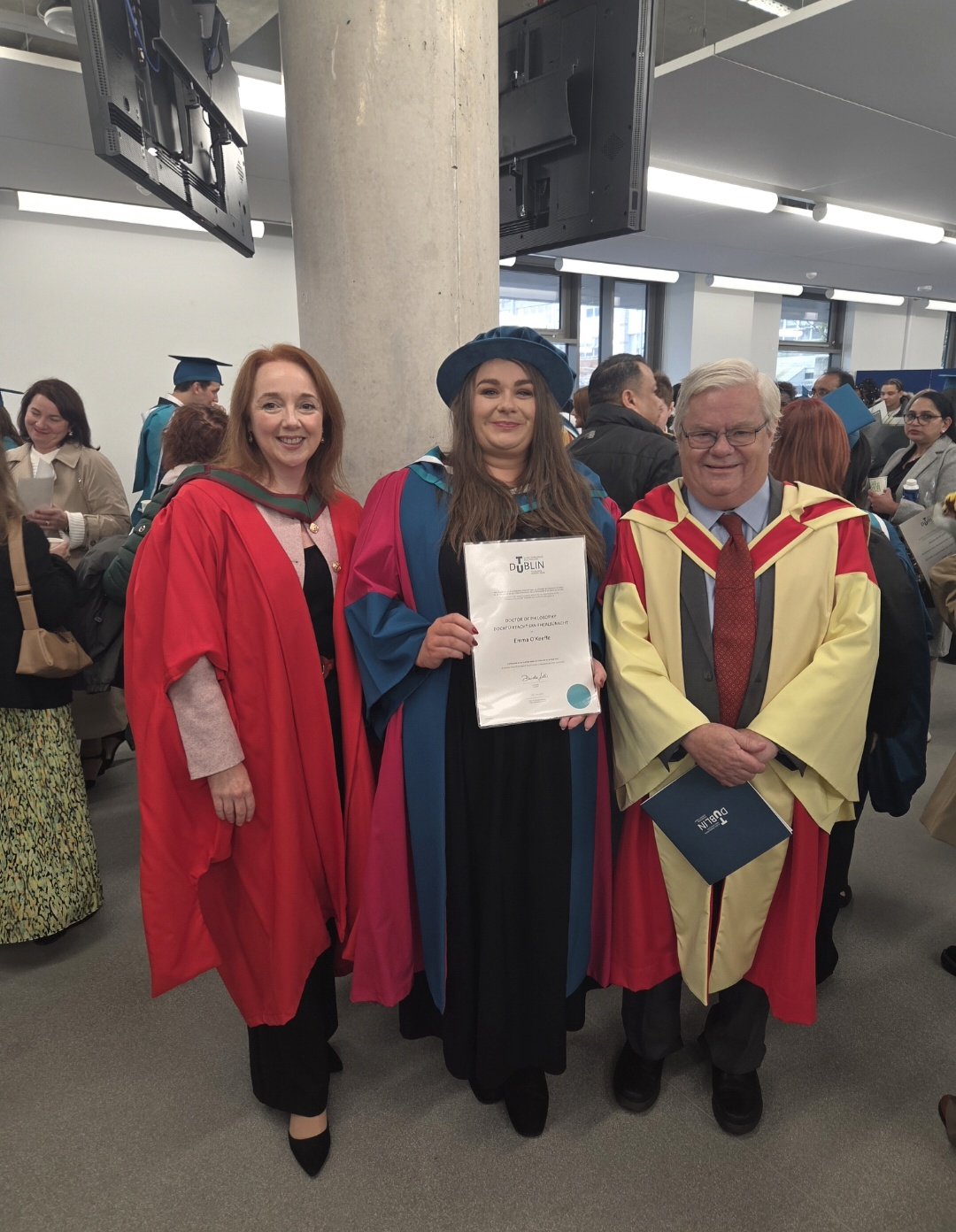
Dr Emma O’Keeffe with supervisors, Dr Maria McHale (TUD) and Dr Kerry Houston (TUD).

What were the biggest challenges you faced during this process, especially moving from academic work to seeing your editions performed?

The biggest panic moment was when the opportunity came around for a performance of the Elegy with a high-profile orchestra in Germany. It was going to be the premiere performance and recording, and that was a moment of total panic for me. I was certain they would find a million mistakes, fire me, and cancel the performance.

It was a big moment of imposter syndrome—I felt a professional should be doing this. I don't think I took a breath during the entire recording; I was waiting for someone to turn around and say, "This is wrong." I had every manuscript out in front of me just in case the conductor had a question! In my naivety, I thought they would have practiced for ages, but they just sight-read it, which added to the panic. Thankfully, it all went well, and there were no issues.

Could you enjoy listening to this first performance of your edition?

I didn't get to enjoy the moment because I was so focused on the panic. However, it was such good experience for me as a young editor in my early twenties. I got the opportunity to talk to the conductor and the lead musicians, and they gave me fantastic, practical feedback. They said, "Next time, try to condense the parts scores to one page," or "We don't like that font or that layout." As a soprano, you're used to doing whatever you like, but now I had to learn to make it easier for the orchestra to follow. It gave me a great insight into how they work as a well-oiled machine.

The ultimate reward was that the pieces I typeset weren't just going to be stuck on a shelf in a thesis for years—they were going to be performed and have gone on to be performed numerous times outside of Ireland.


What was the moment or discovery that truly cemented your connection to Ina Boyle?

I loved looking at all her manuscripts. A handwritten manuscript is a special thing to hold and look at; you know that she touched it and she wrote every note herself. You can trace the development of her music and her hand as she learned from Ralph Vaughan Williams and her other teachers.

But for me, one big moment, particularly emotionally, was when a few members of the Society and I went to visit her house in Bushey Park.

The owner at the time, Chris De Burgh, was super enthusiastic and tried to preserve a lot of the history. We saw the original fireplaces, and there’s a beautiful sundial tiled into the floor of what was the kitchen. It was so surreal being there, thinking, This is where she played music; this is where her family was. It was lovely to see it and that Chris and his wife Diane had an interest in the history of the house as well. There was a lot of restoration and they did a beautiful job. So that was a really big moment for me.

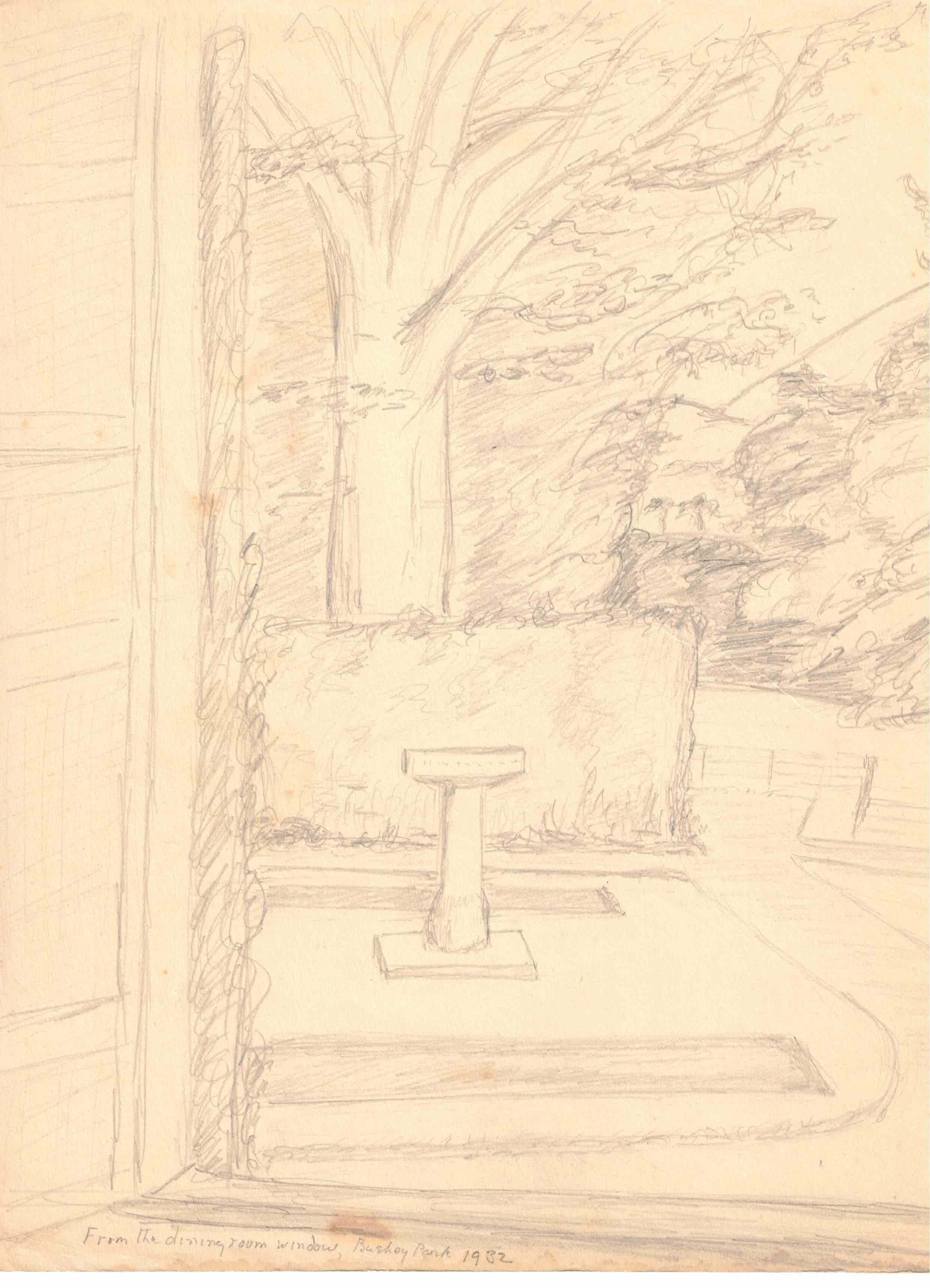
A full-circle moment was seeing a beautiful solid stone bird bath in the courtyard. Later, with the discovery of one of Ina’s sketchbooks, there was a beautiful sketch of that exact bird bath. Her mother’s name is even engraved on it. It made her life completely real.

View from the dining room sketch, by Ina Boyle, 1932.
Image © The Board of Trinity College Dublin

You also mentioned how much her surroundings inspired her. Would you like to see her music performed at Bushey Park again?

Absolutely. I would love to go back just to perform one piece so that the house hears her music again. There’s a beautiful forecourt overlooking the Wicklow hills, and one of her smaller chamber works would be perfect for that setting.

When you’re standing there and looking out at the mountains, you totally understand where her inspiration came from. She was so content at home in Bushey Park and loved it.


Ina Boyle made trips to London for lessons and to network. Do you think staying in Ireland, despite her family responsibilities, was a choice rooted more in her contentment with Bushey Park?

I think she was Wicklow through and through. She was just so at one with Bushey Park, and I believe that is simply where she was meant to be. While her family responsibilities certainly played a part, it’s also the home of her inspiration. I don’t think it needs to be overthought—it was her personality; that’s where she wanted to be, and that’s where she stayed.

People think, Oh, she should have travelled more and had more experience, but what she accomplished just by being in Bushey Park is amazing. It’s important to change the narrative from "what she could have done if she’d travelled more" to recognising the magnificent work she did accomplish right there at home. It’s sad that her music is only coming to life now, nearly 60 years after she passed away, but so many people are rooting for her.

Given the general lack of awareness of female composers, what role should education play in promoting Ina Boyle's work?

There should be a big push to introduce Ina Boyle into music curricula. While many female composers deserve study and recognition, Boyle is arguably one of the most deserving. Ina has everything; all the genres, including orchestral and chamber. There's so much to take from and to learn from. There have been small steps; some of her songs are currently included in the RIAM examination syllabus, mostly on the vocal syllabus and there's a small study on her in the Irish Junior Certificate.

If you had to select one piece of music that you think encapsulates Boyle's genius and should be required listening, what would that be and why?

I don't have one single piece, but I think her orchestral works are some of her best. Her symphonies, like The Wild Geese and Glencree, and her other orchestral pieces are all so great. I am a bit biased towards the two pieces I worked on for my PhD: the Elegy from 1913 and Psalm from 1923.

Those are two super works that it would be a pity if they had never been typeset. When you work with the handwritten manuscripts, it’s a total jigsaw puzzle piecing together all the different sources and variations, but the outcome for those two pieces was fantastic. Even though we don't know what specifically inspired them, you can feel that they were inspired by something special to her. A lot of the music she wrote should now be part of standard listening.

What are your future plans and ambitions regarding Ina Boyle?

I certainly hope I'm with Ina for life! I would feel like I was doing her a disservice not to continue, especially to pay homage to Katie Rowan and Ita Beausang's work.

I certainly hope I’m with Ina for life!
— Dr Emma O'Keeffe

I've just started a new editing project, which I’m hoping to call "Women of Indomitable Will," which is a nice little nod to both Ina Boyle and Ita Beausang. I’m starting by doing some smaller chamber works—such as those for tenor/soprano solo and string quartet—as they have better performance opportunities than the bigger orchestral pieces.

I also have my eye on a couple of bigger works, like The Prophet for baritone and orchestra, which is interesting as it has Russian literary influences—something I haven't seen elsewhere in her work. The goal is to keep getting her music performed. I think it’s a good time now to focus on pieces that haven't been done before, so premier performances and recordings are the aim.

My long-term ambition is to complete the typesetting and editing of her other two ballets from the 1930s. They are much bigger works, but possibly more suitable for performance than her first one. A full performance of a ballet would be amazing, but even an orchestral performance would be lovely. We are lucky to have built up such a good relationship with enthusiastic performers who are just waiting for new editions to play.

Finally, if you could say one thing to Ina Boyle, what would it be?

I think I would simply thank her for her beautiful music. It’s funny, Ita Beausang said ‘Ina Boyle gave you your career’, which is so true. It would be lovely to have known her in some way or met her, but I think the visit to Bushy Park was a big connection to that, and it was really, it was lovely.

We’re also so lucky we had Elizabeth Maconchy and Nicola LeFanu who knew her personally and we have that insight into her life. I think my final word be that I am very grateful to have come across Ina Boyle and that I had the opportunity to be involved with the Ina Boyle Society, and with Katie Rowan and Ita Beausang.

Ina Boyle: A Rediscovery, Wigmore Hall 10th March 2026

Wigmore Hall, the world's leading chamber music venue, is set to host a thrilling concert celebrating the life and stunning compositions of Irish composer Ina Boyle.

This performance, scheduled for 10th March 2026, forms part of Wigmore Hall’s 125th anniversary season.

On the anniversary of Ina Boyle’s death, the incredible artists Ailish Tynan, Paula Murrihy, Robin Tritschler, and Iain Burnside, will bring Ina’s songs to those already enamoured with her music and also to a new generation.

Wigmore Hall

Artists

  • Ailish Tynan soprano

  • Paula Murrihy mezzo-soprano

  • Robin Tritschler tenor

  • Iain Burnside piano

This concert will be approximately 1 hour in duration, without an interval.

“Ina Boyle’s catalogue of compositions continues its richly deserved rediscovery. The Irish composer’s reflective songs, lovingly recorded by three of this evening’s performers in 2020, are a special delight.

On the anniversary of Boyle’s death, they are joined by Ailish Tynan in a programme that places Boyle’s music in company with pieces by her teachers Charles Wood and Ralph Vaughan Williams and her close friend and supporter, Elizabeth Maconchy.”
— Wigmore Hall

IBSL is thrilled by the announcement of this remarkable concert, a fitting tribute that perfectly resonates with the words of Ina Boyle’s mentor, Ralph Vaughan Williams: “I think it is most courageous of you to go on with so little recognition. The only thing to say is that it sometimes does come finally.”

For further information and to purchase tickets, visit the below link to Wigmore Hall.

TICKETS

"The Expansive Canvas": Spotlight on 19th-Century Women Composers

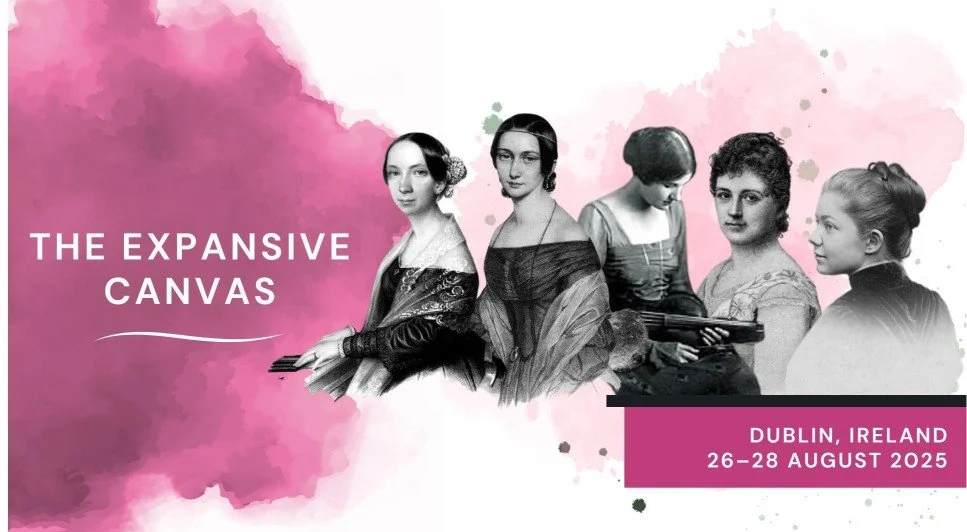
IBSL are thrilled to share details on the upcoming international conference, "The Expansive Canvas: Large-Scale Form in the Music of 19th-Century Women Composers," taking place from 26th to 28th August, 2025, in Dublin.

This much-welcomed event, hosted by the Department of Music at Trinity College Dublin and the Royal Irish Academy of Music, shines a much-needed spotlight on the often-overlooked yet extraordinary contributions of women composers from the "long 19th century" (1789–1922).

The Expansive Canvas Large-Scale Form in the Music of 19th-Century Women Composers International Conference and Collaborative Symposium Dublin, from 26th-28th August 2025.

Image taken from: https://expansivecanvas.com/

The Expansive Canvas explores composers such as the remarkable Ina Boyle, Augusta Holmès, and Fanny Robinson, alongside many other talented women whose legacies deserve wider recognition and celebration.

“This international conference and collaborative symposium aims to reinvigorate our conception of music history.”
— The Expansive Canvas

The conference includes The Expansive Canvas Creative Palette project, curated by conductor Sinéad Hayes. This project is currently seeking creative submissions from the public to form part of the event as a way to respond to these remarkable composers’ music with their own creative projects.

“This is an extraordinary opportunity to take the music of these women out of the academy and into everyday life.”

— Dr Nicole Grimes, Associate Professor of Music at Trinity and Co-Chair of the Creative and Organising Team for The Expansive Canvas conference.

“There’s so much talk about women composers, but if we want people to really engage, they need to get their hands on it. The Creative Palette offers a powerful way in — not through lectures or textbooks —but through creativity itself.”
— Professor Denise Neary, Royal Irish Academy of Music, and Co-Chair of The Expansive Canvas conference.

The conference events will be held across two prestigious locations: the Trinity Long Room Hub and the Royal Irish Academy of Music. This symposium is organised by the Department of Music at Trinity College Dublin and the Royal Irish Academy of Music.

For more information, please visit the conference's official website at https://expansivecanvas.com/ and also view their accompanying video HERE.

Registration is also open, please follow the link HERE for further information.


“As we unearth, contextualize, recover, and promote large-scale compositions by these women composers, this international conference and collaborative symposium offers wonderful opportunities for collaboration in study and performance, as well as within the academy and with industry leaders.”
— The Expansive Canvas

"No Coward Soul is Mine’: A Critical Edition of Select Works by Ina Boyle"

IBSL Artistic Advisory Committee member, Dr. Emma C. O'Keeffe, has made her thesis, "No Coward Soul is Mine: A Critical Edition of Select Works by Ina Boyle," publicly available.

You can now read this significant work through the TUD online archive.

IBSL are delighted to share access to Dr O’Keeffe’s thesis via the link below.

No Coward Soul Is mine

A TRIBUTE TO RONALD CORP OBE (1951 -2025)

The Ina Boyle Society is shocked and deeply saddened to learn of the passing of our dear friend, Ronald Corp OBE.

As a member of our Artistic Advisory Committee and founding Trustee of IBSL with a profound appreciation for Ina Boyle and her music, we feel Ronald's loss acutely today and will miss him greatly.

Ronald Corp OBE

We would like to honour a wonderful composer, conductor, Artistic and Musical Director and send his family and friends our deepest love at this sorrowful time.

Ronald dedicated significant time to the resurgence of Ina Boyle's music and legacy, and in 2018, Ronald was the conductor on the BBC Concert Orchestra album, Ina Boyle: Orchestral Works. Ronald wrote, “Ina Boyle was a major composer who needed to be reappraised and given her rightful place in the repertory.” Today, we at IBSL honour Ronald, himself a significant composer whose remarkable legacy will continue to be praised and celebrated for generations to come.

Codladh sámh, Ronald.

Ina Boyle & Elizabeth Maconchy: a timeless friendship

When discovering more about the life of one of Ireland’s most prolific female composers, Ina Boyle (1889-1967), it's only right to also pay tribute to another incredible female composer whose steadfast friendship and loyalty have been crucial in preventing Boyle's works from remaining hidden. This piece pays tribute to the timeless friendship of Ina Boyle and the remarkable composer, Dame Elizabeth Maconchy (1907-1994).

Elizabeth Maconchy and Ina Boyle, 1955.

IBSL would like to thank and acknowledge Nicola LeFanu for providing the photograph.

As a woman navigating the major historical, social, and political shifts of 20th-century Ireland, Ina Boyle persevered despite personal family commitments that kept her mainly residing in rural Ireland and making few musical contacts. She left a significant body of work, including chamber, vocal, orchestral, and choral works, as well as opera and ballet.

Thankfully, Ina’s mentor, the great Ralph Vaughan Williams' prophecy – ‘I think it is most courageous of you to go on with so little recognition. The only thing to say is that it sometimes does come finally’ – is now coming to fruition. However, without the crucial support of Maconchy, Boyle’s works may have remained unheard.

Born to Irish parents in Hertfordshire, England, Elizabeth Maconchy spent a significant period of her childhood in Ireland. Maconchy ‘was composing for the piano from the age of six and received lessons in piano and music theory in Dublin’ (Source: Dictionary of Irish Biography). Sadly, in 1922, her father, Gerald, passed away. Following this sad time and supported by her mother, who recognised her enormous musical talent, Maconchy ventured to London, where she studied at the Royal College of Music under another champion of Ina Boyle, Ralph Vaughan Williams.

Maconchy most certainly experienced the challenges faced by women in the 20th century who sought to compose. Writing in the ‘Composer’ journal in 1971, under the article titled ‘A Composer Speaks’ (Composer, 1971), she recalled, “So coming to London as a music student was a first plunge into life, and once I had found my feet I enjoyed my time at the R.C.M. immensely. I was lucky enough to win prizes and scholarships and even had a work played by the college orchestra, which was a rare event in those days. But what did one do next, particularly if one were a girl? Sir Hugh Allen said, "If we give you the Mendelssohn Scholarship, you will only get married and never write another note." (Reference: Maconchy, Elizabeth. (Winter 1971-72). A Composer Speaks. Composer, 42, 25-29)

But what did one do next, particularly if one were a girl?

Sir Hugh Allen said, “If we give you the Mendelssohn Scholarship you will only get married and never write another note.”
— Maconchy, Elizabeth. (Winter 1971-72). A Composer Speaks. Composer, 42, 25-29)

Dame Elizabeth Maconchy.

IBSL would like to thank and acknowledge Nicola LeFanu for providing the photograph.

As with Boyle, Vaughan Williams was also a great supporter of his pupil, Maconchy, of whom she commented, regarding studying with RVW, ‘it was like turning on a light’. This special bond can be seen in their many correspondences. Signing a number of his letters to her as ‘Uncle Ralph’, the Vaughan Williams Foundation is a treasure trove of those letters and shines an invaluable light on both their professional and personal relationship with a sense of realism and support. One such letter to Maconchy in 1944 illustrates that sense of realism and just how difficult it was to work as a composer.

But, dearest Betty, you know how impossible it is to judge of a brand new work absolutely on first hearing.
So we want to hear it several times
All my love
Uncle Ralph
— Letter from Ralph Vaughan Williams to Elizabeth Maconchy 1944. Letter listing from Vaughan Williams Foundation

Our dear friend, the late Dr. Ita Beausang, wrote about this difficulty for composers, particularly women, citing the support Ina had from Elizabeth: ‘After Vaughan Williams’s death, Boyle continued to compose, although women composers faced many challenges from concert promoters and publishers. Her friend Elizabeth Maconchy provided safekeeping at Downton Castle for some of Boyle’s scores which could not be posted to Ireland during the war and acted as an intermediary between her and publishers and other agencies. In August 1967, Maconchy listed Boyle’s music in a small green notebook under four categories: ORCHESTRAL, CHORAL, CHAMBER MUSIC, OPERA.’

Boyle left instructions in her will for her trustee to consult Elizabeth Maconchy ‘as to all matters relating to her music as she is the only person who is intimately acquainted with it and my wishes about it.
— Dr Ita Beausang

Her personal tribute, Ina Boyle: An Appreciation, with a Select List of her Music, was published for Trinity College by the Dolmen Press in 1974. Boyle left instructions in her will for her trustee to consult Elizabeth Maconchy ‘as to all matters relating to her music as she is the only person who is intimately acquainted with it and my wishes about it.’

IBSL thanks David Byers for kindly supplying the image.

For further information, please visit ByersMusic.com

Maconchy wrote of Boyle, “Ina’s inspiration almost always came from poetry: even her purely instrumental works were usually headed by a quotation, a few lines, perhaps, which had set off a train of thought and fired her musical imagination.

Her choice of words reflected her wide reading, from translations of early Gaelic poems or medieval Latin lyrics through the poetry of John Donne to that of Edith Sitwell, for which she had a particular affinity. She was always faithful to the mood and meaning underlying the words and to their shape and rhythm, never distorting them for musical effect, but allowing them to speak more fully through her music.”

For further information, please visit ByersMusic.com

Professor Nicola LeFanu

In 1997, Maconchy’s daughter, IBSL Patron, composer, teacher, director, Professor Nicola LeFanu, presented a collection of Boyle’s manuscripts, sketches, and printed music dating from 1922 to 1966 to the Library of Trinity College Dublin. The Boyle archive, which can be accessed online on TCD Digital Collections, has proved invaluable for researchers and performers of her music.

IBSL is hugely grateful to Professor Nicola LeFanu, who wrote, “My mother held Ina’s music in high regard and often tried to get more attention paid to it. After Ina’s death, my mother arranged for the manuscripts to go to the library at TCD, and she also published a short memoir of Ina, since at that date people knew all too little about Ina and her music.”

Writing in 2007 for the Journal of the British Music Society, Professor LeFanu gave a remarkable insight into the life of her mother, a fascinating source for readers, researchers, and musicians alike. Professor LeFanu too shines a further light on the friendship between Ina and Elizabeth, writing that when the latter’s "ballet ‘Puck Fair’ (1939/40) was performed in Ireland, of which Elizabeth was absent, it was Ina who orchestrated the piece for her."

To read more by Professor Nicola LeFanu, please visit here.

My mother held Ina’s music in high regard and often tried to get more attention paid to it.
— Professor Nicola LeFanu, daughter of Dame Elizabeth Maconchy

Affectionately known as ‘Betty’, Maconchy’s musical legacy includes a significant contribution to string music, notably her thirteen string quartets composed throughout her career, a lasting legacy of her chamber music work. She also penned a substantial output of choral and vocal music and three one-act operas. Notable works include, but are by no means exhaustive, String Quartet No. 5, The Land (1929), Proud Thames (1953), Héloïse and Abelard (1978), and the aforementioned one-act operas: The Sofa, The Departure, and The Three Strangers.

Writing for the British Music Collection, Martin Anderson celebrates the life of Maconchy, whose “accomplishments are to be marvelled; she chaired the Composers’ Guild of Great Britain, was President of the Society for the Promotion of New Music, and in 1987 was appointed Dame of the British Empire.”

Please see this link to read more, and Maconchy’s music records are listed here also on the British Music Collection website.

The timeless friendship of ‘Ina and Betty’ is not only heartening, as they so clearly meant so much to one another on a personal and professional sphere, but they also demonstrate how each championed women in music in a period of history that, regardless of their efforts to succeed, placed so many obstacles in their way. To look back on both legacies of Boyle and Maconchy is to acknowledge and celebrate two remarkable women who pursued their passions for music, gifting future generations with timeless pieces that will live on.

Boyle and Maconchy’s composer contemporaries include greats such as Joan Trimble and Rhoda Coghill, and at IBSL our mission is to champion female composers, past, present, and future. We have so much more to learn from Boyle, Maconchy and all of these remarkable women, and hope you will join us at IBSL as we continue to champion their work.

This is just the beginning!

IBSL would like to pay particular thanks to Professor Nicola LeFanu.

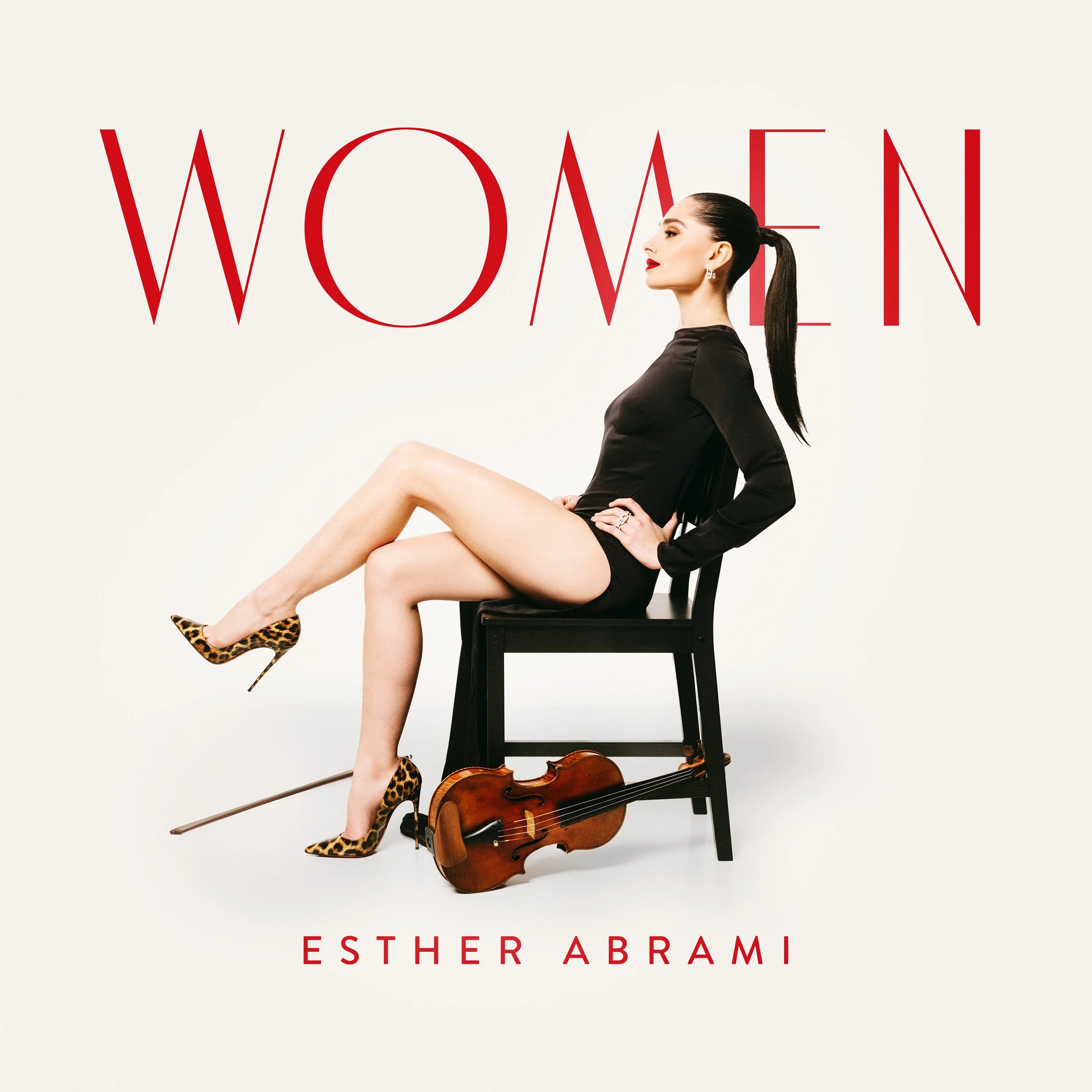
Esther Abrami's 'Women' set for release feature Ina Boyle!

IBSL is so excited to share that the incredible, award-winning concert violinist Esther Abrami will release her new album 'Women' in April!

'At its heart is the world-premiere recording of Ina Boyle's Violin Concerto'. (Sony Music)

Esther Abrami

‘Women’

Image from Sony Music

“For as long as I can remember, classical music composers were men.

It took stepping out of my formal education, to question this reality. ‘Did any women ever compose classical music?’ Turns out they did!”
— Esther Abrami

‘Women’ will release on 25th April 2025 through Sony Music.

IBSL wishes Esther huge success and looks forward to the album!

Learn more about Esther here and follow her on Instagram here.
Follow this link to pre-order ‘Women’.

Ina Boyle Newsletter February 2025!

Exciting news! The Ina Boyle Society has released its February 2025 Newsletter, packed with fascinating updates and insights. Click here to read!

Dive into a world of Ina Boyle rediscovery, with an edition full of the latest developments from IBSL, including details on upcoming performances of Ina Boyle’s works, news of exciting emerging musical talent, and opportunities to contribute to the growing legacy of Ina Boyle and other neglected female composers.

Check it out now, and don’t forget to encourage your friends to subscribe!

Irish Heritage Bursary Winners

Huge congratulations to the winners of the Irish Heritage Bursary Auditions! These talented musicians impressed at the auditions held at Wigmore Hall earlier this month.  

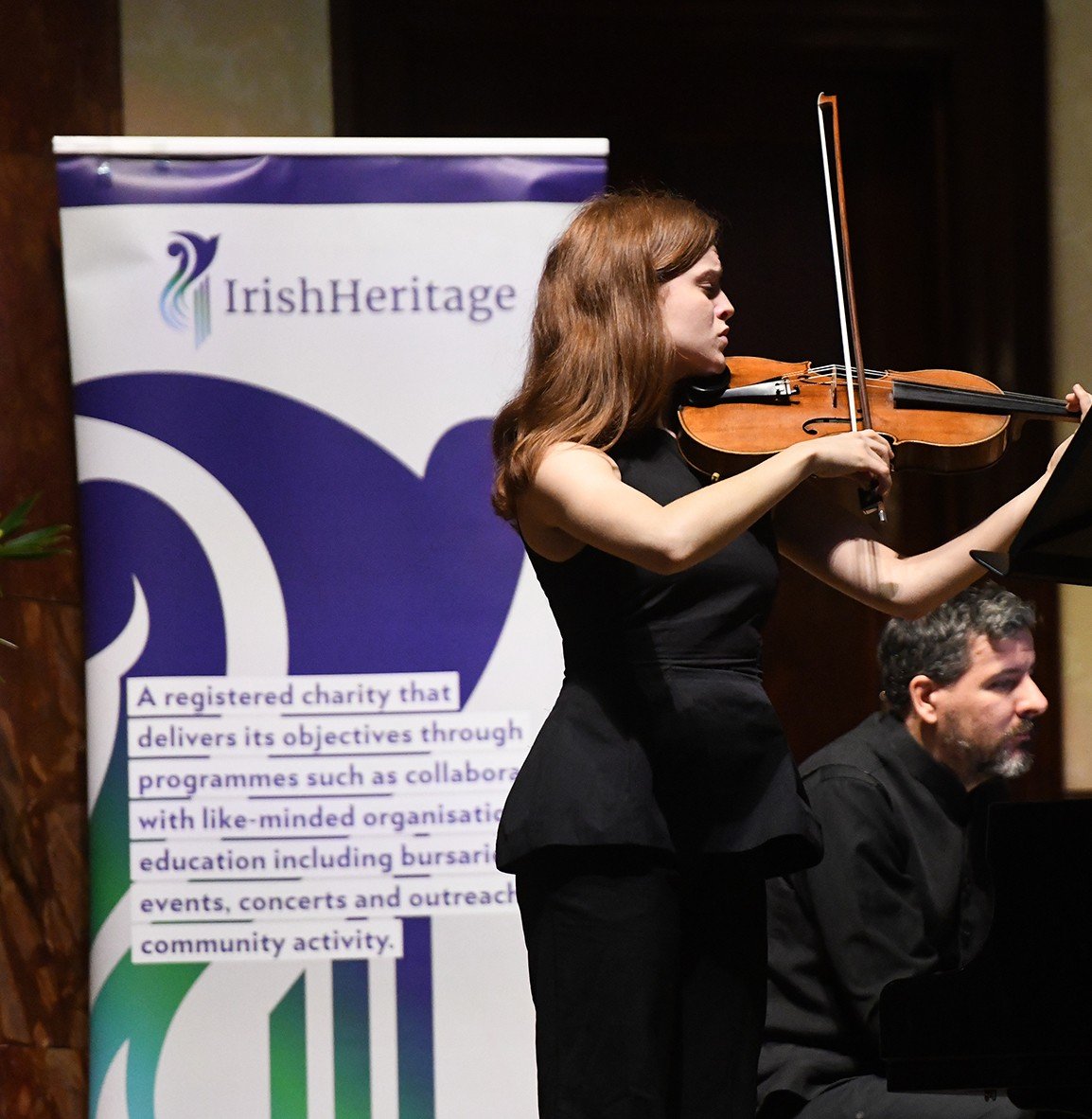
Among them was Dublin-violinist, Eve Quigley who kindly shared her thoughts with IBSL on including Ina Boyle’s Phantasy in her programme.

‘My name is Eve Quigley, and I am a violist from Dublin in my fourth year at the Guildhall School of Music and Drama. Last week, I was honoured to receive the Irish Heritage Homan Potterton Bursary for Strings, following an early morning performance at Wigmore Hall in London.

A highlight of my programme was Ina Boyle’s Phantasy for viola and piano—a remarkable work that I had the privilege of exploring with the brilliant pianist Craig White. It was a joy to delve into Boyle’s evocative sound world, from the grandeur of sweeping chords to spirited marches, culminating in a deeply expressive, soulful melody. It was such a pleasure to explore this beautiful piece, and I am excited to continue discovering more of Ina Boyle’s music in the future! 

In the coming months, I will be performing at St James’s Piccadilly on 30th April at 1 pm, and at the Guildhall School of Music and Drama on June 10th at 6pm.’ 

Eve Quigley & Craig White.

Image from Eve Quigley.

See the full list of recipients below, and join IBSL in wishing them glittering futures.

Irish Heritage Bursary for Performance: Dida Condria (piano)

Homan Potterton Bursary for String Instruments: Eve Quigley (viola)

The Brackaville Bursary for Vocal Studies: Emily Hogarty (mezzo-soprano)

BVOF Special Award: Thomas Kelly (percussion)

Eve Quigley & Craig White.

Image from Eve Quigley.

Ina Boyle and International Women's Day 2025

IBSL is excited to share that our good friend and Artistic Advisory Committee member, Dr Emma O’Keeffe, will be celebrating both Ina Boyle's birthday and International Women's Day on Saturday, 8th March, with a presentation on Ina Boyle's life and works at this year's Finding a Voice Festival in Clonmel, Co. Tipperary.

Poster from Finding a Voice

Founded in 2017 by sisters Róisín and Clíona Maher, over the past eight years the festival has featured music by hundreds of women composers, from the twelfth-century nun Hildegard of Bingen to newly commissioned works by Irish composers.
— Finding a Voice Music Festival

This year’s Finding a Voice festival will feature performances from leading Irish and international musicians of music from across eras and genres.

Dr O’Keeffe will feature on Saturday, 8th March (Ina Boyle’s birthday) at 10:30am in Clonmel Library, Co. Tipperary.

Women in Music

Date: Saturday 8th March 2025

Time: 10:30am

Location: Clonmel Library, Co. Tipperary

Poster from Finding a Voice

Learn more about the Finding a Voice festival and how to attend this year's events by following this link here.

IBSL sends best wishes for a successful Finding a Voice festival.

Ina Boyle at the West Wicklow Chamber Music Festival

Ruth Gibson & Fiachra Garvey

Image from the West Wicklow Chamber Music Festival

Wicklow's own Ina Boyle will be among the celebrated composers featured at this year’s West Wicklow Chamber Music Festival!

Ruth Gibson (viola) and Fiachra Garvey (piano), who have collaborated for over 20 years, will perform Boyle's "Phantasy" on 8th May 2025, the opening night of the festival.

A spellbinding opening on Thursday 8th May featuring one of Ireland’s foremost violists, Ruth Gibson, and the festival’s Founder and Artistic Director, Fiachra Garvey.

This extraordinary duo will present an inspired programme of both iconic and rarely performed works for viola and piano.
— West Wicklow Chamber Music Festival 2025

Tickets for this year’s festival are available to purchase from the WWF website via the link below:
Date & Time: Thursday 8th May 2025, 8pm

Venue: Russborough House, County Wicklow

Ticket Info: Tickets €42 / €21 student concession (+ booking fee)

TICKET INFORMATION

Thank You, Angela Brady, for Your Invaluable Contributions to IBSL

Angela Brady OBE

IBSL would like to thank Angela Brady OBE for playing such an integral role in the society for a number of years.

At the end of 2024, Angela stepped down as Trustee and Director of IBSL. We are enormously grateful to her for her commitment and wise counsel during what has been a pivotal time of change and development for the Ina Boyle Society.

We are enormously grateful to her for her commitment and wise council. 
— Katie Rowan, Founder of IBSL

A big thank you, Angela! We are pleased that despite all your commitments you will continue to support us as an important friend.

IBSL Chair & Musician Emma Coulthard to Perform in 'SacrumProfanum'

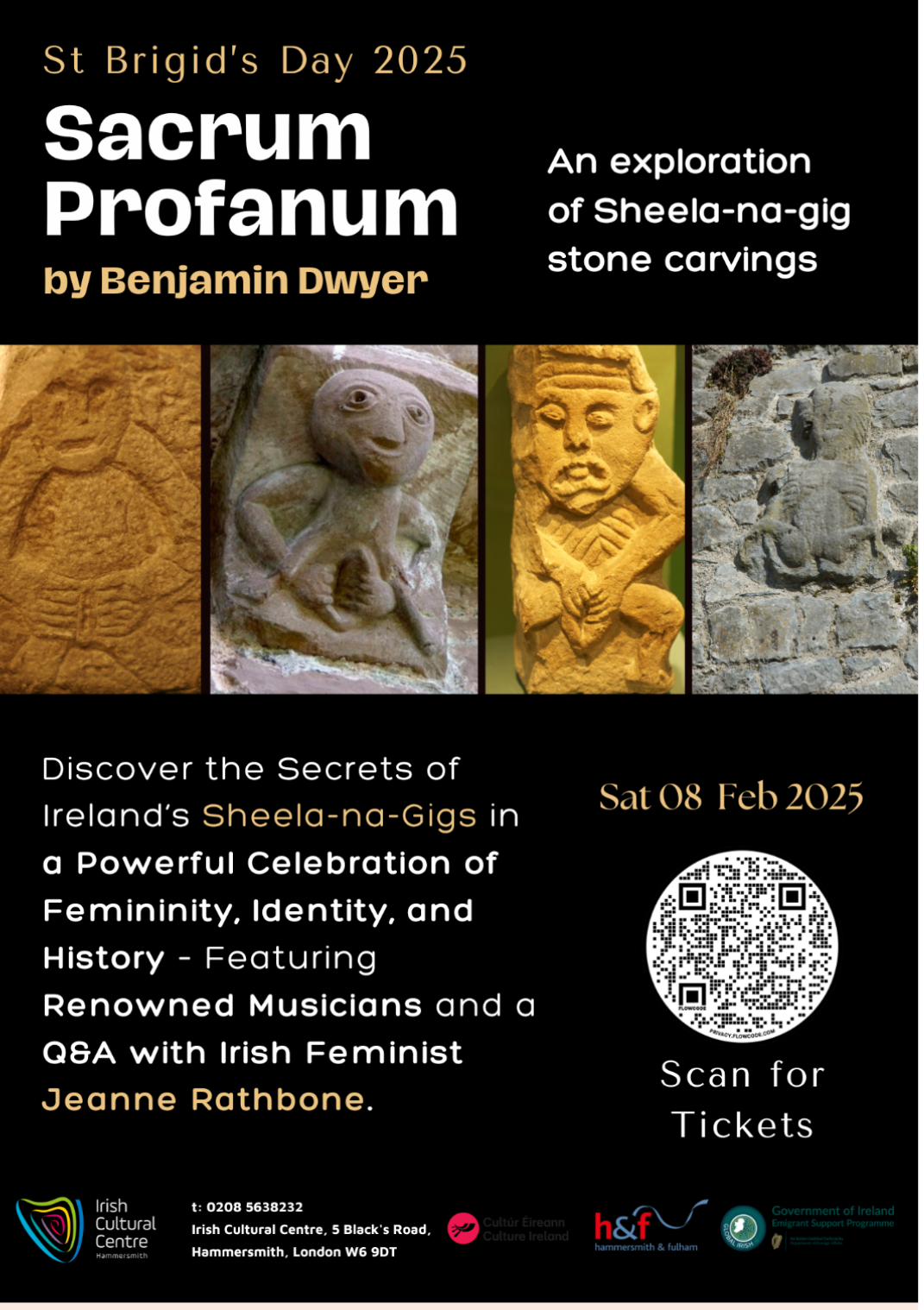
The closing of St Brigid’s Week 2025 at the Irish Cultural Centre in London will feature the incredible musical experience, SacrumProfanum.

SacrumProfanum by Benjamin Dwyer featuring musician Emma Coulthard.

The Irish Cultural Centre, Saturday 8th February, 7:30pm.

Poster image from the Irish Cultural Centre Hammersmith

According to the ICC, SacrumProfanum “created by renowned Irish composer Benjamin Dwyer, delves into the powerful symbolism of Ireland’s enigmatic Sheela-na-gigs – ancient stone carvings that embody themes of femininity, identity, and resilience.”

SacrumProfanum blends contemporary classical music with traditional Irish forms, featuring 11 original compositions brought to life by an ensemble of world-class musicians.
— ICC Hammersmith

ICC writes, “SacrumProfanum blends contemporary classical music with traditional Irish forms, featuring 11 original compositions brought to life by an ensemble of world-class musicians. Through live performances, recorded music, and spoken word, this evocative work explores Ireland’s history and its treatment of women through the watchful gaze of the Sheela. From haunting melodies to visceral rhythms, the concert captures the raw power and poignancy of these mysterious figures.”

The performance features IBSL Chair and musician, Emma Coulthard on flutes.

Following the performance, there will be a Q&A when Irish Feminist, Author and Activist, Jeanne Rathbone will interview SacrumProfanum’s composer, Benjamin Dwyer.

Ticket information can be found here and doors open from 7.30pm.

Please note this performance includes adult content.

Dr Emma O'Keeffe Awarded PhD

Dr Emma O'Keeffe.

The Ina Boyle Society is delighted to share the news that our great friend and Artistic Advisory Committee member, Emma O’Keeffe, has been awarded her PhD.

Emma has been a key contributor to the Ina Boyle revival over the last 9 years, and her PhD is a major piece of work, and one that focuses exclusively on the orchestral music of Ina. 


The following are extracts taken from Dr O’Keeffe’s thesis.

The title of this thesis is drawn from one of Boyle’s vocal works, No Coward Soul is Mine (1953)for contralto solo and string orchestra, based on a poem of the same name by Emily Brontë (1818–1848). The choice of title is a reflection of Boyle’s perseverance, determination and valiant commitment to her compositions. She must certainly be considered a heroine of twentieth-century Irish art music, and her once forgotten contribution is now being deservedly recognised. In a letter to Boyle, written in May 1937, Vaughan Williams acknowledged her tenacity and offered words of reassurance: ‘I think it is most courageous of you to go on with so little recognition. The only thing to say is that it sometimes does come finally’.

‘No Coward Soul is Mine’: A Critical Edition of Select Works by Ina Boyle (1889-1967).
Dr Emma O'Keeffe.

Through the creation of modern typeset scores, this project aims to improve the visibility of Irish women composers. More often than not, visibility comes through performance; therefore, creating digitally typeset scores is an important contribution to musicological scholarship in Ireland. Using essays, editorial policy statements and explanatory notes, the ultimate objective of this project is to produce a critical, typeset edition containing a scholarly curated text of the select works. It also aims to stimulate an interest in other scholars to discover Boyle’s music and to create future typeset editions from her large collection of neglected compositions.

This project is the broadest Editing project of Ina Boyle’s compositions to date, exploring the different genres that she composed for, and by journeying through a selection of major compositions from different stages in Boyle’s life.
— Dr Emma O'Keeffe

‘No Coward Soul is Mine’: A Critical Edition of Select Works by Ina Boyle (1889-1967).
Dr Emma O'Keeffe.

The editions produced as part of this project will give conductors, musicians, performers, scholars, and audiences greater insight into the original material and, in many cases, offer the first performance materials to accurately reflect the composer’s vision. In the case of Ina Boyle, who often composed quickly and created versions for a variety of ensembles and contexts, original manuscript sources contain numerous errors and inconsistencies.

The primary focus of the IBSL is to ensure that all of Boyle’s manuscripts are typeset and edited so that her music is readily available for performances. This project, therefore, aims to contribute to the current research on Boyle’s music. However, this recovered history of women in Irish art music, goes far beyond Ina Boyle in our understanding of Irish musical culture.

Boyle composed steadily throughout her life and her oeuvre covers a wide range of genres including, a substantial amount of choral, vocal and orchestral works, solo songs, chamber music, and various stage works including, three ballets and a single opera. The selection of works edited as part of this project explored one work from each decade of Boyle’s career in order to illustrate the breath of her compositional life. Beginning with her first completed orchestral work as a young composer, Elegy in 1913, to another first for the composer, a ballet, the Virgilian Suite, composed during one of her most creative periods, and finally, one of her last completed vocal works, Three Ancient Irish Poems in 1958. Although Boyle had a distinct preference for string writing, in particular the cello, this selection also demonstrates the broad range of ambitious ensembles with which she engaged.

‘No Coward Soul is Mine’: A Critical Edition of Select Works by Ina Boyle (1889-1967).
Dr Emma O'Keeffe.


The Ina Boyle Society extends its warmest congratulations to Dr Emma O'Keeffe on this wonderful achievement and looks forward to our future collaborations.


In memory of Dr Ita Beausang (1936-2024)

Image © Library of Trinity College Dublin.

Ita Beausang

The Ina Boyle Society is deeply saddened and moved by the passing of our dearest friend and Patron, Dr Ita Beausang.

It is no understatement to say that without Ita’s dedication and exploration of Ina Boyle's life and legacy, the movement to reignite this great Irish composer would simply not be. Ita was a remarkable force for Irish music and academia, leaving a legacy of her own that will be treasured by those who knew and loved her and in the future generations to come.

“Without the dedication and ongoing support of Ita Beausang, especially in the early days, the renaissance of Ina could never have happened and is her legacy.

Knowing and working with her over the years has been a privilege and a joy.
Her wise and loving counsel will be sorely missed.”
— Katie Rowan, Founder of IBSL
“I will remember Ita’s warmth and generosity, her spirit and enthusiasm shone through, and will remain with us all.”
— Emma Coulthard, Chair IBSL

A unique luminary of the music world and champion of Irish women in the arts, Ita will be profoundly missed by us all. As we mourn the loss of this remarkable woman, we are committed to honouring her memory by continuing to promote Ina Boyle’s music, strengthened by the passion and vigour of Ita’s tireless work. We will be forever grateful to have known Ita and to have had the great joy of working alongside her. 

We send our heartfelt thoughts and prayers to Ita’s family at this time.

Codladh sámh, Ita.


Ina Boyle performance in Canada

The Ina Boyle Society is always delighted to hear of Ina's music being heard across the globe. We were particularly thrilled about a performance earlier this month in Canada by Musicologist and Performer Dr. Orla Shannon.

Dr. Shannon, a guest speaker at a colloquium talk at the School of Music, University of British Columbia, Vancouver, performed Ina's songs, introducing them to new audiences.

Dr. Orla Shannon & Fergus Kwan: ‘Ina Boyle (1889–1967): A Journey of (Re)Discovery through Art Song’, School of Music, University of British Columbia, Vancouver.

Invited by Dr. Laurel Parsons, a pioneer in publishing analysis of music by women composers, Orla's talk, 'Ina Boyle (1889–1967): A Journey of (Re)Discovery through Art Song,' also included a performance of Ina's Three Medieval Latin Lyrics with a fantastic pianist, Fergus Kwan.

Dr. Orla Shannon & Fergus Kwan: ‘Ina Boyle (1889–1967): A Journey of (Re)Discovery through Art Song’, School of Music, University of British Columbia, Vancouver.

As Ina's compositions continue to be performed worldwide, the Ina Boyle Society remains committed to sharing her legacy with future generations and thanks Dr. Orla Shannon for her continued support of Ina and her work, and for showcasing Ina’s music across the world in Canada.

Dr. Orla Shannon & Fergus Kwan: ‘Ina Boyle (1889–1967): A Journey of (Re)Discovery through Art Song’, School of Music, University of British Columbia, Vancouver.

Rediscovered Ina Boyle Sketchbooks

A truly wonderful occasion at Trinity College Dublin this month, when composer Mary Kelly donated two rediscovered treasures from Ina Boyle to The Library of Trinity College Dublin. These were two of Ina’s drawing sketchbooks that Mary’s father had saved during a public auction at Ina’s former home, Bushey Park.

The sketchbooks included portrait drawings by Ina Boyle of Clyde Twelvetrees, Charles Wood, C.H. Kitson, and Ina’s mentor and teacher, Ralph Vaughan Williams. Thanks to Mary’s wish to safeguard them, they will now be housed with Ina’s other artefacts in The Library of Trinity College Dublin.

The legacy of Ina continues to grow, and we hope to attract more interest in her life and work, given the important place she holds within Irish Musical history.
— Emma Coulthard, Chair IBSL

Attendees at the TCD presentation included composer Mary Kelly, Roy Stanley, and Jane Maxwell from The Library of Trinity College Dublin; Emma Coulthard, Chair of the Ina Boyle Society; Dr. Ita Beausang, biographer of Ina Boyle; IBSL Artistic Advisory Committee members David Byers, Ian Fox, and Dr. Kerry Houston; Diane Davison, former owner of Ina Boyle's home, Bushey Park; and David and Isobel Beausang.

L-R: Diane Davison, Dr. Kerry Houston, Mary Kelly, Ian Fox, Dr. Ita Beausang, Roy Stanley, Emma Coulthard, David Beausang, David Byers, Isobel Beausang and Jane Maxwell.

Image credit © Library of Trinity College Dublin.


Mary Kelly shares how she came to have the sketchbooks in her story, ‘Miss Boyle’s Sketchbook’.

“I grew up near Enniskerry village where Miss Boyle (children in those days always referred to adults by their titles so she will forever be Miss Boyle to me) was a familiar sight driving up and down to the village in her bottle green Morris Minor. My father and my aunts (who lived closer to Bushey Park than we did) used to tell me what a talented composer Miss Boyle was and that she was frequently performed by the BBC but was not appreciated in her own country.

As a young child, I had been to Bushey Park a few times. On one of these occasions, my friend and I were asked to deliver a message. Miss Boyle’s housekeeper brought us into the kitchen and offered us some orange squash. Children in those days were expected to politely accept hospitality. The problem was, Miss Boyle had a reputation for feeding the rats in her house, treating them as pets. We were concerned that perhaps a rat had been in the squash jug but good manners required that we drink it!

Though not known as the talented composer that she was and despite a reputation for being a little eccentric, Ms. Boyle was considered in the neighbourhood to be kind, modest and devout. After she died, my father brought me to the auction at Bushey Park. In the hall, there was a heap of rubbish in the corner clearly on its way to a dump. My father, an amateur artist who had an eye for such things, spotted a drawing book among the rubbish. He told me to pick it up thinking that there could be a few blank pages in it for me to draw on.

When we got home, we discovered her drawings. How glad I am that I did not draw on the backs of any of those pages! I kept the drawing book all these years hoping that one day, it would find a proper home. When I graduated with a B. Mus. in 1978, my aunts urged me to do a Masters on Miss Boyle. Life got in the way and I regret not having taken their advice but am so glad that she is finally getting the recognition that my father and my aunts knew she deserved.

I am delighted that the sketchbook will finally be where it belongs.”
— Mary Kelly, Composer

L-R Mary Kelly, Dr. Ita Beausang, and Emma Coulthard.

Image credit © Library of Trinity College Dublin.


Emma Coulthard, IBSL Chair on the donation by Mary Kelly: ''On behalf of the Ina Boyle Society, I am really pleased that the sketchbooks, which give us an intimate portrait of Ina, are going to be part of the collection at TCD. The legacy of Ina continues to grow, and we hope to attract more interest in her life and work, given the important place she holds within Irish Musical history. We would like Ina's contribution to be celebrated more widely and her work to be an inspiration to all who create or perform them.”

Upon presenting the sketchbooks to Trinity College Dublin, Mary Kelly said, “I am so happy that the sketchbooks are now where they will be well looked after,” and Roy Stanley from The Library of Trinity College Dublin wrote, “Thanks to this generous donation by Mary Kelly, future scholars will now have a more complete picture of the range of Ina Boyle’s talents.”


Ina Boyle biographer, Dr. Ita Beausang on the rediscovery wrote,: “The Sketchbooks are timely assets for future study of Ina Boyle's life. Mary Kelly's generous donation has kept them safe and Trinity College Library is the ideal place for Ina Boyle's archive.”

L-R: Diane Davison, Dr. Kerry Houston, Mary Kelly, Ian Fox, Dr. Ita Beausang, Roy Stanley, Emma Coulthard, David Beausang, David Byers and Isobel Beausang.

Image credit © Library of Trinity College Dublin.


IBSL would like to thank Mary Kelly for her generous donation, our attendees at the presentation, Jane Maxwell and Roy Stanley of Trinity College Dublin and Aileen Cahill from The Contemporary Music Centre Ireland for introducing us to Mary Kelly, enabling the presentation to TCD where the sketchbooks will be housed with Ina Boyle’s other manuscripts.